Sally Temple - Cells, Leadership & Audacious Innovation

The eye is often referred to as the window into the soul. Whether that is true or not depends I suppose on who’s doing the viewing, as the subjective interpretation invariably dictates the meaning. This however in science can be balanced via rigorous protocols of evidence based assessment in a clinical setting and peer review. The subjective becomes objective and the perspective become clearer. In the stem cell field some of the earliest approaches to regenerative medicine have been in the CNS, with a number of high profile clinical stage multi and pluripotent trials. Those in the clinic with ongoing trials are reporting promising indications of disease stability and restorative potential. More data is required but the overall momentum moving forward portends to a variety of treatment methodologies from a number of cell sources. An active area of CNS clinical research has been for the retina, where there are unmet medical conditions in need of new effective solutions for low vision & blinding diseases. Early attempts to restore retinal function via the transplantation of donated adult and fetal retinal tissue and cells were deemed inefficient and lacked solid efficacy data. Those experiments however have paved the way for the current focus on using more developed & novel multipotent cells, as well as from pluripotent sources. One such retinal program is being led by Dr. Sally Temple of the Neural Stem Cell Institute based on a unique population of adult retinal stem cells. I sat down with Sally at ISSCR 2015 and it's fitting she rounds out the Interview segments from Sweden as she is ISSCR's President Elect now and is looking to the future, as we all are, with high expectations and great promise to meet those tangible opportunities head on.

The Neural Stem Cell Institute (NSCI) is home to some of the most interesting work in stem cell technology today. Its origin as a research hub for neural cell investigation lies with Sally's history and her pursuit and discovery of the first CNS stem cells in the mouse. As with a number of other leading scientists she started with uncovering complex neural biological systems and the mechanistic pathways of cell constructs of the CNS, which included the eye. She is the recipient of the MacArthur "Genius" Award and a highly respected leader in the field.

NSCI is funded by the NY State NYSTEM along with donations as a non-profit and is based in upstate NY - near Albany, in a town called Rensselaer. It holds a foundational patent estate to an adult stem cell discovery that now forms the lead translational focus of the institute - an adult retinal stem cell in the RPE layer which can be sourced from donor tissue and expanded to therapeutic doses. This same cell can also form a variety of other cell types via a biological trans-differentiation pathway called the EMT into bone, fat and cartilage. The team has published a number of high profile papers (eg 1,2,3) on the science which underpin the clinical translation work. Their projects have many prestigious collaborators, including the Kellogg Eye Center and Mount Sinai, amongst others.


The eye is uniquely interconnected as a sensory organ, yet accessible, which has made it a natural target for NSCI to lead off with. The program is earmarked for a clinical trial in the not too distant future. RPE cell transplants are a hot cell therapy area. A number of groups are in clinical trials using various different sources and application methods using RPEs - notably Ocata, Riken, Coffey/Pfizer & BioTime/CellCure. Some groups are also in the clinic using different retinal cells, while others still are in various pre-clinical stages of development. All this attention and focus on the eye is for a good reason - it's accessible and in-vivo activity can be observed in detail. However, most importantly the momentum is building as the data reported to-date is showing safety & potential efficacy.  

Sally's team at NSCI includes her co-founder & partner Jeffrey Stern, a retinal surgeon, and a notable listing of well respected scientists and researchers, including: Chris Fasano, a leading member of the investigator team, who is also known for producing the official ISSCR Stem Cell Podcast with Yosif Ganat.

The work at the institute is not solely eye cell centric, as you will see when exploring the various sub-sections of the research going on there. The basic theme throughout is indeed neural and CNS in general.

Stem Cell Podcast w/ Sally Temple


The adult stem cell discovery that Sally, Jeff and collaborators at their NSCI uncovered has resonated throughout the community. It's simplicity is captivating and it's implications far reaching. The very nature of regeneration and the body's own capacity to heal itself is powerful stuff. That is what we all wish for, methods by which we can assist our own abilities in all manners throughout our lives - why not also with our own health.


Yet, there is still a basic question to be resolved - if there are these cell populations in our organs & tissue, just waiting for those cues, can we indeed awaken our "Inner Salamander?"

I hope you find the interview transcript below informative. I have great admiration for innovators and no more so that those that fight for patient solutions in a not-for-profit foundation. 

Good luck Sally, Jeff and all the team in my home State!

Cheers

Interview 

M - Can you explain your discovery of an adult retinal stem cell and use of that for research and therapeutics.


ST - The idea for discovery research and looking for retinal cells that might have regenerative potential I have to attribute to my husband Jeff Stern. He started in basic research and decided he wanted to work with people and went to medical school. He ended up coming back into the field of ophthalmology but with that research mindset. We of course talked over the years about neural stem cells and the discovery of tissues that you’d think don’t have regenerative potential but actually do.

M - Stimulated to have that potential?

ST - That’s the point. I firmly believe that we have that ability and if we can simulate it we can.

M - Somewhat like the salamander effect?

ST - Exactly. So Jeff put in recently for the Audacious Goals competition of the National Eye Institute. All the applications were anonymous so no one knew who submitted what and it was open to everyone, worldwide. They picked 10 winners and one of those was Jeff’s project. He was picked for “Reawakening your Inner Salamander” to take advantage of that.

M - I like it. I used a salamander image a little while ago - it’s a poignant reference.

ST . It is and of course the salamander RPE can regenerate and make the entire neural retina. So if you remove the photoreceptors and you remove the neural retina entirely in salamanders the RPE cells will change, proliferate and then make new retina cells.

M - Was this an area of study for you and your husband?

ST - We were aware of that because when Jeff worked in vision doing physiology, the physics of electrical physiology, he worked with salamanders and so he was very familiar with the regenerative literature and we thought let’s look in the human eye for a stem cell and if so could it be activated. We did experiments to establish these stem cells in the human system. We grew them in clones so we could watch an individual cell and see how many progeny it could make.

M - From what source?

ST - We took it from human cadaver tissue and we removed the retina and took the RPE, which you could obtain very cleanly. We removed the anterior portion of the eye, which people have said may contain proliferative cells in perhaps a ciliary margin.

M - The Canadians?

ST - Yes, Derek van der Kooy and Vincent Tropepe. In some animals there’s a ciliary margin but it’s not as clear where the ciliary margin is in humans but just in case we removed the anterior portion. We wanted to look within the RPE and we wanted to make sure we knew what cell type we were looking at. We cloned them and made movies of them. We took them from the eye and demonstrated that only a sub-population, less that 10% and in some preparations only 3% of the RPE cells will divide extensively.

M - Do you believe in-vivo they do that on a regular basis or are they stopped?

VPR - Fibroblastic Scar (UCL image)
ST - In-vivo people have found it very hard to see any proliferative cells but there are circumstances in which the RPE is thought to proliferate. Unfortunately under certain pathological circumstances you will see the RPE layer migrate through the retina and out into the vitreous and proliferate through creating these awful contractile membranes which will pull the retina off. That type of epiretinal membrane formation is quite common.

M - Almost like a mutated cell process.

ST - It’s like some of the cells are undergoing some of the transformative processes of the EMT state. So we knew there were circumstances under which some of the RPE can proliferate in-vivo. Perhaps sometimes this can be beneficial. Maybe they could proliferate a little bit and help the retina recover from damage.

M - They already do a lot of work.

ST - Yes, the RPE are amazing. They’re such a humble little cell but if they die the retina dies. That’s how important they are. They are important for the blood retina barrier, fluid balance, cytokine protection, phagocytosis and more. So we found a sub-population of the cells will self-renew extensively making hundreds and thousands of cell progeny from one cell.

[discussion break]

M - To recap there are adult retina cells that can proliferate as evidenced by the EMT phenomena and that if stimulated can be a source of retinal tissue

ST - Exactly, so the idea is there’s a sub-population that can be activated to proliferate. If those are the cells that contribute to those abnormal masses we don’t know for sure but what we do know is that the cells can proliferate. We can take a single cell and make numerous progeny. We can split those prodigy up so now we have clones of those originals that you can then put in different media.

M - More so than what was achieved with fetal cells?

ST - I don’t know if they cloned a single fetal cell. These are adult cells that we cloned out. From a single cell we get a clone and put it in different media conditions and we have shown that the same cell that can give RPE can also produce fat, cartilage and bone.

M - Along the MSC line?

ST - Yes so RPE can make MSCs and can undergo EMT. We think that could be a good model for the epiretinal formation. We don’t know if it’s the originating cell in-vivo but it can do that. It was a surprise because you wouldn’t have thought of a CNS cell giving rise to MSC progeny.

M - I’ve spoken with Dr. Maher in Barcelona who is pioneering a lot of work on wisdom teeth and he says the same thing in reverse. They can make neural crest cells and other non-MSC cell types, plus the MSC lineages . Does this have to do with the CNS connection also?

ST - The CNS is the brain, the retina and the spinal cord. The neural crest of course is from the dorsal part of the neural tube and its migratory. The cranial neural crest does have progenitors that give rise to bone and cartilage etc. A mixture of cells, as well as neural cells. We know that our cells are CNS cells at the beginning and are probably not going through the neural crest stage. They don’t seem to make sensory neurons and sympathetic neurons etc. We don’t think of changing RPE into neural crest. For some reason the RPE has retained the potential to make MSCs for whatever reason. I can’t explain but that is the case.

M - Have you done genetics on that?

ST - Yes we’re in the process of doing that now and studying this progression into MSCs because we want to understand that so we can prevent, but that happens pathologically. At the same time we know we can take those cells and make beautifully stable RPEs for 2 years in culture.

M - and make a lot of them

ST - Yes a lot of them. From one donor we can make 5 x 10⁸ cells which is a lot. Let’s say a patient age-related macular degeneration may require 50,000 or 100,000, because you’re only covering that tiny macular region, we hoping one donor’s cells will be able to treat hundreds of patients. We have made plans for all the moving parts. You have to get manufacturing and regulatory to approve so we’re not doing it ourselves. We’re using a facility and transferring the technology so we know they are making the highest quality cells.

M - This is an academic institution?

ST - Yes it is. An academic GMP facility at the University of Rochester and they’ve been wonderful. We do a lot of back and forth to make sure the cells are correct.

M - This is sort of a NY project?

ST - It is mostly. It’s funded through the NY State via the NYSTEM program. We wouldn’t have been able to do this without them. They have been tremendous. It’s very expensive. We have got to solve this problem of why it costs so much to do this. They gave us $10.8m over 4 years to do all the preparations for the manufacturing and the efficacy to get to an IND. What we’re hoping once we get through that process is that we can then move into clinical trials.

M - If you can show there’s a signal. I’m not sure if you’ll need to go through a small trial to get to that stage.

ST - Probably a Phase 1. We’re planning about 18 patients. It’s very interesting to be in an area like this. In the beginning people weren’t talking very much about the RPE and then there was a recognition that this would be a great target tissue because it’s the eye and you can actually watch what’s happening once you put the cells in. There are sensitive visual tests.

M - Have you added all those specialists to the team now?

ST - Yes. Jeff of course is a retinal surgeon.

M - Will he be part of the trial?

ST - We think it’s important to be hands off with the safety study, so it will be done independently. That way we have some comfort. We’ll know the cells are safe and there will be no conflict.   

M - Once you publish you can receive credit.

ST - The efficacy data to-date is really exciting.

M - Using the RCS rats?

ST - Yes, the RCS rat. You know people have said with that model anything works. This is not true.

M - You can look at the past examples

ST - We haven’t published yet but what we have shown is that the cells have to be at a particular stage of development.

M - That’s what I’ve been talking about before and with the community here.

ST - Robin Ali?

M - Yes that’s right Robin Ali’s work and clinically with Dr. Lanza’s trials having used cells differentiated to a certain point.

ST - There’s a sweet spot in the developmental profile - the earliest proliferating cells and the latest mature cells don’t work as well as cells in the middle of the process.
M - Yes. It’s important to get there as efficiently as possible, extract, freeze & thaw?

ST - Yes. That sweet spot was a surprise so we’re lining up all these elements to use the cells. I do feel good now having different groups using different sources. Some using iPS, some using ES some putting them on a scaffold and some injecting a suspension - like we plan to do.

M - I spoke with Masayo Takahashi the other day, she’s wonderful, and she was explaining how excited her team was about the progressional steps they’re taking from monolayer to suspension. There’s an acknowledgement that there’s a need for suspension in certain cases.

ST - Oh good. I’m glad she’s doing that.

M - That was very important to hear as I felt there was the advanced stage but there are of course other stages. Robin Ali felt that photoreceptors need to come into play more and importantly so as to restore function & vision. That’s certainly true depending on the disease, state of the eye and point in time. The patient acceptance of surgery along that progression is vital to understand because if you’re looking at 20/40 or 20/80 you're going to have a different opinion than if you were 20/200+ so there is an issue there imo.

ST - So Jeff, if he was here, he would say to you “I’m a retinal surgeon and if there was a non-surgical solution I would prefer it.” That’s why we’re excited by the cell we’ve identified as it’s in our eyes. The RPE is so neat, it’s actually laid down in the embryo so when we look at the eye it’s the black center. Those cells were done when you were in utero and really don’t proliferate very much. So we think that’s one of the reasons we’ve been able to activate them from even a 99 year old. They haven’t been used up. There’s no hayflick limit as they haven’t been dividing and dividing and exhausted. They have preserved their potential to divide. We take them out and put them in culture. These cells from 99 year olds that have not divided for a century will start to divide in 36 hours.

M - Source therefore is not that big an issue for you. Is it the standardization in the manufacturing area that will be a challenge?

ST - Not really, cadaver eyes are readily available because they are already collected for corneal transplants

M - The donor consent forms are already there.

ST - Yes. People are so wonderful in their generosity because these are light & vision saving possibilities. So the cornea is already taken, we take the part that is generally thrown away and utilize that. They’re available and they’re in us. So if they’re there and we could activate them safely for an endogenous repair that would be the goal.

M - Have you seen the BMP4 inhibition study from Derek van der Kooy’s team? He was trying to do something similar. Evidentially there was some form of stop in his cells also and they’re working to find some chemical formula to regulate inhibition but you have to be very specific otherwise they show off target effects.

ST - The RPE cells in-vivo don’t divide very much, if at all, the question is whether this is because of inhibition or the lack of activators. So what we found is we can take growth factors that stimulate the growth in-vitro and put those in the eye of animals and they do activate the cells. We think lack of activators is probably one of the reasons and we can add these. At the same time it’s possible that if you add in something that Derek is describing you get even more activation but I think you have to be very careful. You don’t want too much activation because there would be a concern there you could get a growth.

M - jCyte are doing some interesting work. They’re looking at delivering the factors by way of cells intravitreally.

ST - Yes we’re looking to actually isolate the factors

M - CIRM has funded their program. Henry Klassen is moving it and they’ve got an approved IND for RP [since this interview clinical trial has started - see here].

ST - Yes he’s putting cells in to protect

M - He experimented on different formats and settled on the cells as factor delivery vehicles as his approach first

ST - Good idea

M - There are other possibilities for action via MSCs intravitreally or systemically plus via some of the recent work on neuroprotection using photoreceptor progenitor factors. Is that something similar in how it may work?

ST - Perhaps. I know that Jensen are putting umbilical cord cells under the retina

M - They haven’t been too revealing in terms of data

ST - Right, that’s something I would say is so helpful if we’re working in the same area to share as much as possible because we learn from each other. I don’t know what they’re doing and it’s a highly sensitive area of the body, so safety is a key issue. So to have to inject subretinally once may be ok, but to have to do it repeatedly is a concern. Certainly if you could do an intravitreal injection of an activating factor that has great appeal.

M - Is that where you’d like to get to

ST - Yes. Our animal studies in that area are progressing. We think we have a pipeline developing

M - So the first would be the transplant then during that phase you would develop the concept further?

ST - Yes the endogenous stimulation that’s exactly what we’re doing

M - That’s a plan that will be successful imo - the degree of success is yet to be seen of course but it’s worth every effort.

ST - Of course

M - I noticed you were working with the Israelis on an element of the protocols using NIC expansion. Are you utilizing some of that methodology?

ST - We also grow iPS cells and I think you’re referring to Eyal Banin and Benjamin Rubinoff and the use of NIC. We find it is beneficial yes.

M - It helps with proliferation or how?

ST - Not quite sure what it does to the cells but it helps the differentiation of the cells and they look robust.

M - Do they over mature as a result?

ST - I don’t think so

M - Ok there’s a sweet spot issue that’s important

ST - Yes so that is the case for our adult cells, which I mentioned we’re preparing a paper on.

M - When’s that due out?

ST - Oh yes, I think Richard Davis, who’s working with us on that, would say “ah, the figures are almost all done, writing it up”

M - In the post!

ST - I know, it’s in the post! I’ll will let you know when it’s ready.

M - Thx, would love to read it. I think we’ve covered so much, just a few more notes here. The Allo source, is there a need for immunosuppressants - systemic or local dose? How will that work?

ST - I have to say when doing a clinical trial you have less leeway than you’d imagine on these different details. We’ve been encouraged to do a very strong immunosuppression early on and part of our clinical team includes physicians that specialize in immune issues in the eye. A uveitis specialist. We recruited a very prominent scientist at Mount Sinai, his name is Douglas Jabs. So we’re aware of that. Because the RPE is the blood retina barrier if it is diseased you could get it broken down. So we’re starting with Allo and the tissue is prevalent and available enough that we could HLA match to help reduce the immune issue. Then, given the cells are already in the eye, if the activation product doesn’t work we could probably do an extraction & expansion for an autologous transplant of cells.

M - Would you do an iPS or a retina stem cell sample from the eye?
ST - We’d probably take it directly from the eye

M - Because a skin biopsy or blood sample is easier

ST - It is. We also know we can take these cells from the subretinal fluid. They’re there and it’s probably just going into the subretinal space and sucking some out. The reason we know this is that in certain circumstances they have to take out fluid such as in a retinal detachment and normally that is thrown away. We have a protocol to grow cells from that. It’s small scale and it doesn’t work every time but we’re not actively trying to harvest the cells right now, but in theory it could be done.

M - I’m very happy for you and your team - it’s great work. At the end of the day fighting hard for the future solutions is really all about the next generation and what we can do for our own loved ones who are older. If we can stop this evil circle it will be worth it and try to do it in a way that makes it economically viable. Thank you so much Sally.

ST - Thank you.

Refs:

ISSCR 2015 Annual Meeting Coverage


I recently attended the annual meeting of the International Society for Stem Cell Research and have been writing up the coverage in dedicated articles which you will find the links to below and also to the right.

The interview with Dr. Sally Temple entitled "Cells, Leadership & Audacious Innovation" can be found here.

I wish to thank the ISSCR for the opportunity and to Michelle Quivey, Snr Comms Mgr, for her professional handling of the media scheduling.

Cheers


ISSCR 2015 Introduction


Stem Cells & The Aging Brain - Karolinska Symposium


Biotech Spin-Outs: Discovery > Company


Media Hype | ESi Bio | CIRM's Chairman


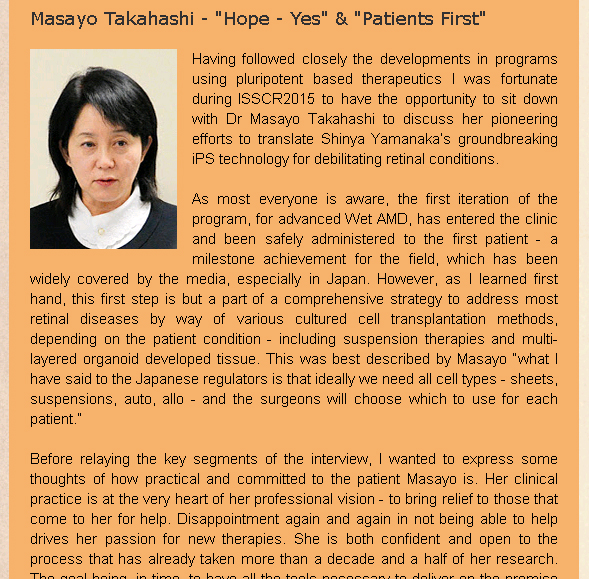
Masayo Takahashi - "Hope - Yes" & "Patients First"


GDF11 | Adult MSCs > MS | NYSCF Mito/NT


The Pluripotency Trilogy


Jeanne Loring - Parkinson's, Mice, DNA, hPSCs & Rhinos


Utility by Design - Bio-Engineered MedTech Devices


Congressional Debate Heats Up on Germ Line Editing

Recently a story by Sara Reardon for Nature broke that the US House of Representatives had introduced as part of the 2016 spending package a Bill that would seek to add restrictions on top of already existing regulatory provisions and guidelines in respect to human genetic editing of embryos, sperm or eggs (germ line cells).

The idea would be to restrict access to federal funds to evaluate or permit proposed research applications in this area. This would in effect stall any positive progress in the US in respect to basic biology questions in regard to potential solutions for inherited genetic disorders. Mitochondrial technologies that are being considered would for example be effected by this ban.

In addition, the language in the House Appropriations Committee's Bill would look to establish an “an independent panel of experts, including those from faith-based institutions with expertise on bioethics and faith-based medical associations” to review recommendations from federal advisory institutions, such as the US Institute of Medicine (IOM), with regard to such technologies and their use.

Non-viable embryos would be notably allowable under these new proposed rules for research purposes.

The US National Academy of Sciences (NAS) who oversees the IOM are due to conduct a review of the human gene editing area later this fall, as noted in the video below and detailed in the NAS/NAM press release here.

As a few have pointed out the involvement of "faith-based institutions" doesn't seem to warrant concern as the topic is for the entire community to discuss and participation from all members is recommended. Consensus can only be legitimate if all voices have had equal representation in the discussions.


However, this I believe is more to the point. Where does it state that democracy first establishes law then allows inclusive debate? This initiative seems on the surface to be more of the same rather than a genuine effort to collaborate on an effective and universally applicable set of guidelines for legislative consideration in all international jurisdictions. 

Cheers

Germline Science & Embryo Use - The Law & Scope for Applied Research


NIH statement on editing human embryo DNA
The recent reiteration by the Director of the NIH, Dr. Francis Collins, that the long held legal position of the US Federal Government is to not fund destructive embryo research, brings the US debate on germ line editing front & center in practical terms.


"Use" of human embryos, for their own benefit, is written into the established Directive 98/44/EC of the European Parliament and of the Council of 6 July 1998 Recital(42) on the legal protection of biotechnological inventions in European states et al and is a foundational document addressing this area. The interpretation of this document has led to the European Patent Office guidelines and appeal rulings. 

However, apart from the embryo "use" issue, the Directive (Chapter 6.2.b) specifically states that "processes for modifying the germ line genetic identity of human beings" are prohibited from Patentability.
Also, the "Convention for the Protection of Human Rights and Dignity of the Human Being with regard to the Application of Biology and Medicine: Convention on Human Rights and Biomedicine Oviedo,4.IV.1997" states "An intervention seeking to modify the human genome may only be undertaken for preventive, diagnostic or therapeutic purposes and only if its aim is not to introduce any modification in the genome of any descendants." This forms part of the overall European Convention on Human Rights, in all its parts "The Convention."

So in Europe the issue of Human Rights & Innovation Patentability are determined by guideline standards applied mainly throughout the membership via The Convention & the BioTech Directive, while Individual National Laws are deferred to, fundamentally by design, in determining the applicable interpretations & standards governing the specific ethical/moral & "ordre public" of that society in biomedical research.

In the US, it's also the actual "use" of embryos for research, including the derivation itself of ESCs, that is the Federal funding restriction. This is a result of, exclusively at the time of drafting, the destructive method employed to derive hESC lines. In addition research funding into destructive embryo studies in areas such as nuclear transfer & genetic modifications of the germ line were also restricted, as a result. The reiteration of this established position recently by the NIH reminds all of the reality of the current funding law governing destructive practices on "human embryos."
However, historically there has been somewhat of a mixed approach in practice applied to federally funded embryonic research in the US. The NIH has authorized funding for decades using donated IVF supernumerary embryonic stem cell lines for research. On the one hand the law states that no funding is allowed that destroys embryos (e.g. blastocyst ICM extraction of stem cells, or in this most recent case genetic editing on embryos that would result in their destruction). However, on the other hand, this law doesn't apply when work is done on Federal registry approved embryonic stem cell lines (see NIH guidelines). This reality is a middle way compromise to support the nascent field of advanced research into developmental biology and has resulted in significant progress in the understanding and therapeutic potential of pluripotent cell technologies.
Of note, more recent non-destructive methods, nor research using non-viable embryos, have yet to be written in. For example, non-embryo-destructive sourced Blastomere ESCs, nor non-viable SCNT-ESCs or Parthenogenetics-hpESCs, are notably excluded from federal support. So the actual working model isn't that current nor flexible to the evolving technology, which is reason to review the legislature as a result of the sector’s broadening scope.
The use of natural eggs in SCNT-ESCs/hpESCs was perhaps the concern and avowed aspect of these methods to the Federal Government - but has there been a recent review on this position given IVF has become a standard option in fertility treatment? Also the sector is moving fast and emerging reprogramming techniques look to create synthetic eggs, what then? Is this not a reasonable question to be asking now, given the discussion?     
This line can and may very well be taken further with technology to create synthetic sperm. Will the combination of synthetic eggs and sperm be the next ethical issue? I believe there needs to be a concerted effort to get ahead of the science & write updated Laws that apply new guidelines with scientifically prudent standards, while remaining open and flexible to potential benefit & future possibilities.

Further, the European Court of Justice has ruled recently that non-viability is a determining characteristic of the definition of a "human embryo," therefore non-viable zygotes & arrested/mutated pre-embryos that cannot develop do not fall within the restrictions of the Biotechnology Directive, as they have been ruled not to be considered by definition an "human embryo." However controversial this position may seem to some it is an accurate reflection and interpretation of the foundational biotechnology law in Europe, while deferring to national member states the issue of ethical/moral & "ordre public."

Fundamentally the underlying principles of the protection of life in the Chapter 1 Article 2 of The Convention doesn't state explicitly that germ line cells, nor for that matter an embryo or fetus, are to be given specific reserved consideration. This has been tested at the European Court of Human Rights. Should national laws allow in-vitro research on embryos The Convention states in Chapter 5 Article 18 that they should "ensure adequate protection of the embryo" and that "the creation of human embryos for research purposes is prohibited." This is the general positioning at the European Human Rights level, as a result of the union of culturally diverse member states. As previously indicated, individual countries apply local Laws to their societal ethical positions, which they all do in regard to embryos/ESCs, genetics, IVF & fetal development, considering The Convention. Generally the principle of human rights & dignity extends to all human beings and for that the definition of a "human being" is central to The Convention's interpretation. The UN's Universal Declaration of Human Rights is similarly worded and looks to respect individual human rights, while leaving the question of developing life to individual societies.

With regard to cloning there was a specific Protocol added to The Convention in 1998, and enacted by other governing bodies internationally, as a result of the discussions surrounding animal cloning at the time. Specifically, The Convention states that "any intervention seeking to create a human being genetically identical to another human being, whether living or dead, is prohibited."

The objections to assisted reproduction by the Vatican or Christian Right may very well be subjectively valid, from their reasoned perspective, but that view, however correct or positioned to be morally sound, doesn't acknowledge nor properly address the very real practical issues inherent in today's advanced fertility, cell & genetic sciences. Many of the issues previously debated are being clinically applied with results. New ethical challenges and redefinitions are required by all as the science evolves, with appropriate regulatory & societal frameworks adapted, as necessary.
The fact that new technological advancements are being designed to address medical needs of those that suffer from, or may fall victim to, potentially treatable biological conditions warrants considered thought as to how best to unify behind the effort to achieve a host of goals in the process. Through public education and the application of successful next generation technology the substance and impact science can have on solving the very issues that divides opinion is possible.

The ethics of today will give way to the ethics of tomorrow, and so on - it's nature's way. Man plays his part in this cycle and uses what is available with intellect and inventiveness. Change is a process of adjustment and one could say that is the will of nature's law. The only unnatural aspect would be if man himself becomes defined as synthetic, which is, from this writer's perspective not the goal.

Germ line editing in clinical practice is indeed unnecessary at present until proven otherwise. However, basic research using gene editing technology of germ line cells is necessary, based on clearly defined updated ethical frameworks - with governmental support, if possible. The recent ISSCR Connect discussion on the issue was well presented and reasoned. More open dialogue is required and opinion sought from all stakeholders. There are too many questions yet unanswered to not search for the clues by all means so one day we may apply that knowledge to human frailty & suffering in developing or developed humans. That goal would be best served by furthering basic research efforts using genetics back to our original cells. iPS technology wouldn't have been invented had it not been for human embryonic research, which wouldn't have been possible without animal cloning studies…. the shoulders' metaphor applies.

From my perspective if gene editing research using germ line cells and pre-embryos is to be limited entirely to private companies then that would curtail potential scientific progress in research using non-viable donations or technology methods which cannot develop into a human by design.

Congress has the opportunity to get ahead of these issues and address squarely this area of leading biotechnology innovation in new legislation. This was shown to be important during the protracted court case against the Federal Govt.’s funding of scientific research using approved hESC lines. The high court ruled in favor of the Govt. but there was considerable discussion in legal circles of the need to update the law. The underlying legal basis being the Dickey Wicker amendment, which was written in 1995, and is considered by many to be too ambiguous and not a suitable legislative document for the sector moving forward. The need for a comprehensive bill is generally acknowledged. The use of Federal funds in developmental biology research should allow for opportunities to explore all non-destructive areas of the science to advance medical knowledge so that it does not impede the progress of scientific discovery for the benefit of all. Patients' interests must be considered paramount and consensus sought on majority based positioning. Public education can be an effective tool in defining such efforts.  
For example, currently there is an area of ambiguity with the written NIH hESC text on embryo donations, as a cell can be harvested from a pre-embryo and used for that embryo's own benefit, if not for all.

Ethical considerations are required to be taken into account, but not at the expense of an agreed roadmap to progress. If after broad inclusive deliberations legislative regulations & sector guidelines are updated, then that achieves the goal. However, I would add a caveat, it’s important to include into any new laws the non-viable/non-destructive aspects succinctly, as well as a considered inclusion of a benefit review for technologies applied to viable potential human embryos in-vitro & in-vivo.

However, "use" of embryos isn't the full picture. There remain issues of scope with respect to reprogramming technology, assisted reproduction techniques et al which should be clearly stated as part of new regulations & guidelines in the area.

Clarification is needed as to the somatic reprogramming limits that are acceptable and where there should be restrictions, if any, applied. Synthetic forms of human germ line cells and the creation of pure or part-synthetic embryos for cellular harvest cannot be overlooked and needs similarly considered language. Issues such as same sex couples wishing to use technology to assist having "natural" babies using reprogrammed cells back to the germline, artificial wombs and attempts at eugenics et al should be broadly covered in the legislative language.  

If there were clear legislature on the issues, after dialogue with all stakeholders, this would assist in eliminating the negative spin on today's advancing scientific discoveries that looks squarely to cure disease. Science would benefit from that clarity. The future possibilities would remain, however, guidelines would be established.

Consider if you will that if the science advances and we are able to achieve that long string of .999s on safety, what will be the benefit/risk scenario if implementation occurs some time in the future? Such science can be debated at that point and submitted for consideration, as long as there's a benefit window.
Generally in the future there may be a manner in which genetic technology proves its human potential for the application of germ line intervention. Leaving that door closed while holding a preexisting key isn't such an unethical position IMO - flexibility in today's fast paced scientific world is important.

The challenge in establishing regulations in this area will not be easy, but it isn't insurmountable. A flexible legal & regulatory basis for steps forward in the research is what is required IMO. Checkpoints along the way so that the whole map is not null if one road is opened up upon the presentation of correct documentation. A straightforward mechanism should be agreed for the review process that encompasses the appropriate nominated bodies. Congressional oversight may be appropriate but the nature of such a flexible system would be best served to have it's own adaptation authority once the law is written.

I have stated previously that the reduction in IVF supernumerary embryo creation should be a stated goal with new specific governance stipulations & authority guidelines over the fertility sector. This I believe is central to a consensus building working model.

The point is we as a society cannot any longer avoid the reality of the present and promise of the future by applying yesterday's fixed reasoning to bear. Without informed, concise & regularly updated language of the day the necessary support and freedom to research innovative solutions to pressing medical and biological issues will be unnecessarily limited.

Today the US is the leader in ethical biomedical technology but without Bold Action, Decisive New Legislature and Increased Government Support, across the board, the promise of tomorrow's technology with not meet the expectations of the people nor address the full potential for American solutions for the Common Good.

Cheers


References:

Germline Editing using CRISPR-Cas9 - Totipotent Cell Research

Dr.Yorgos Nikas/SPL
Yesterday the first published paper was released detailing the preliminary scientific attempts at modifiying the germline of a human fertilized egg - a zygote.

What was striking here wasn't so much the attempt being officially published but the storm it has caused in the scientific community.

The science is far from effective and needs a great deal of work before it is even possible to consider using in a clinical setting. That much was shown. There are many steps before any such work should be even contemplated, as guided by the ISSCR in their call for a clinical moritorium on proceding with any human translational work. I personally believe that position will be respected given the laws in place that govern such human germline science. If there is a precedent the ban on attempts to pursue human cloning has shown to be effective.

What is curious here in respect to this work, undertaken in China, on germline editing is that it has quickly followed the cautionary notices by the scientific community leadership that the science was being practiced in human germline cells. This was and is a signal that there is much more going on behind the scenes than we know and that the nature of such developments isn't necessarily coordinated or managed in any practical manner. To some that is the issue perhaps...

The explosion of interest and experimental use of gene editing technology has opened up a proverbial Pandora's box of issues that have yet to be addressed collectively in a meaningful manner. But as these things go it's not always possible to steer scientific advances as the peer review process is built to open up the knowledge gates to replicability and improvement - hence the strength in it's design. Coordinated stakeholder dialogue is urgently needed and initiatives established.

Man's curiosity and pursuit of knowledge has driven momumental changes in our own lifetimes - that is accelerating and those that wish to somehow control the speed of which it is happening may find themselves catagorized as part of the old guard and not hip to the trending interwoven nature of the instant always on tech culture of today and tomorrow.

The ever expanding numbers of brains educated to think of new solutions to existing problems with ubiquitious tools made easy will allow discovery and experimentation to flourish. No one should be surprised when this momentum spawns innovation - especially in the new frontier of biological system design.

My comments on Paul Knoepfler's Blog about the natural reservations of the developments are below:

"Thx Paul for the viewpoint. 

I believe you´re correct to have reservations about the unknown steps on the discovery path to gene line editing. However, I do believe it's important to participate in order to have any chance to mold the outcome. As we have just learned the science is indeed moving ahead, like it or not. I don't believe debating the merits of the possibilities does justice to the technology - at least to me that doesn't seem productive at this stage. 

Some may not wish to go down this discovery path but as many have pointed out - it's not something anyone or even a group(s) can put a halt to, it seems. 

I would like to see the West actively engaged in an initiative to put a scientific team of institutional investigators together to spearhead a collaberative international effort to lead coordinated research into geneline editing - in all it's forms (there are many of course research methods to explore). This way the open nature of such an initiative would be beneficial to all stakeholders and those on the ground can draw down from this central resource.

Attention grabbing science papers as a methodology to present the public the work being done adhoc doesn't strike me as proactively getting ahead of the issues... 

Also, isn't it possible to establish a seperate arm's length oversight department, in an existing organizational structure? This would officially sanction & coordinate the independent local discovery groups to inform and assist the lab work & validate data collection for the entire space. Or are we looking at global independent action, reaction, applied science and IP castle building for human elitism?"

Belmonte paper ref

Further on the issue of gene editing, today Juan Carlos Izpisua Belmonte’s group published a paper in Cell that suggests a possible route to modify mutated mitochondrial for disease elimination using an alternative to the above "CRISPR-Cas9" technology but similar in puprose "TALEN" system.

The sum of these parts and the overall emerging landscape of profound medical advancements is a net positive IMO, while there remains a need to establish a collective approach to coordinating the possibilities for Common Good.

Cheers

The Rise of Germline Science - Human DNA Modification


Genetic modification of human DNA to correct disease causing code has long been a stated goal of medical science. Ever since the discovery of the double helix has man dreamed of understanding the inner workings of its own self, at its very core. The successful mapping of our genome took us closer to that universally acknowledged ambition. Time has not stood still since then nor has science strayed yet from its intended course. The rapid expansion of practical applications for genetics addressed to medical needs is a testament to the pursuit of that knowledge for good. In time there will be more progress and deeper understanding of the impact changes to our code will have - in the meantime research must continue apace and the wings of discovery allowed to extend outwards.     

My perspective on extending genetic research to germ line DNA editing is in line with the recent guidance from the International Society for Stem Cell Research (ISSCR). 

Rather than positioning early, and perhaps prematurely, the ongoing conversation is best taken forward with open engagement and presentation of additional scientific data, as it becomes available. Without additional ethical germline research, supported by industry & regulators, the topic of whether there is reason for undue concern cannot be fully addressed scientifically, apart from debating the broader question of should we (which is conditional imo). To reach any natural conclusion will take time and further industry wide clinical application of non-germline editing technologies, acceptance of less invasive genetic modification technologies, such as mitochondrial transfer, and the implementation of other embryo technologies for human benefit. 

An observation that underlies the issue is perhaps the historical fear factor effect of the "dual-use dilemma." That is to say the mere fact that there exists a possibility of misuse of scientific discoveries has in the past created significant barriers to progress and inhibited otherwise important developments in the timely advancement of research efforts to eradicate human disease & suffering.  Human cloning wasn't on the agenda when Dolly was born, however the realization that SCNT technology had a possible "dual-use" potential has hobbled otherwise beneficial therapeutic sources for ES cells. The entire field of "embryo" science has itself been caught up in an unproductive polarization issue of creation, life & intervention for cell science application. Even today only a very small percentage of the public actually know science is able to establish ES cell lines across all "embryo" technologies in a non-destructive ethical manner for personal & universal cellular treatments. This generally needs to be factored in when discussing the topic as it's unethical in itself not to address the fundamental reasons for many objections to "embryo" science and how it has clouded the perspective of delivering solutions to those in need. Solutions need to be sought, compromise established & educational outreach in the mass media targeted to this very point to end the divisiveness. This germline debate presents an ideal opportunity for such rapprochement.

How is early genetic modification of DNA at the germ/embryo stage going to be any different than the hES cell source miscues of the past unless the rhetoric of the applied technological benefit conversations reflect the lessons learned? 


Getting ahead of the issue is important, as it is with all emerging technological innovations that involve health. However, ensuring the safe sector development of recombinant DNA isn't the same as the ethical impact of human cloning, creating tens of millions+ supernumerary IVF embryos, engineering synthetic eggs/sperm & embryos, conducting germ line editing for disease or introducing DNA species' enhancements et al. These topics aren't challenges for science to overcome alone, they are fundamentally moral & ethical questions of benefit and use. They require careful scientific study, presentation in an open forum (not pay walled), thoughtful inclusive dialogue, education and public outreach.

Perhaps Leadership should suggest specific beneficial goals and propose a working version of a current dual use limitation charter when addressing the issue in the public framework. This will enable the field and public to express themselves within a clearly defined yet productive manner - i.e. what is potentially acceptable to Leadership and what isn't at this stage. Otherwise I can see the conversation repeating itself along the same lines as the media spin of scientific hyper reporting for readership numbers & incorrect assumptions of SCNT=human cloning, which was & still is an acknowledged no-go area in embryonics. Remember this concern set the tone for almost 20 years now of fallout in the field, not as a result of any specific efforts to progress human cloning but for the open door it presented. This was irrespective of the inherent scientific value in autologous ES cells & the sound pursuit of careful research driven embryo based technologies.


History has presented a number of important dual use dilemmas over the course of human history, nuclear power may have been/is the most impactful to human life: energy versus war; restraint versus force; detente versus annihilation; rule of law versus rogue use... One can do the trade offs in perhaps more applicable sciences, for example: synthetic life forms; biological constructs; chemical engineering et al. We live in a never ending cauldron of possibilities where all outcomes increasingly exist as a result of human ingenuity. The rule of law and our moral codes are the only binding principles that the community can foster to fundamentally shape human will. If there is a need for new laws then do so with factual education, public debate and openness centered around a health priority of "for the people" being paramount. However, competitive currents in science run deep today and as such active participation with guidelines would seem the only logical course. 

If there were publicly exposed real life cases where germ line modification would alleviate suffering & disease in newborn children then I would recommend that be shared as widely as possible. Certain neurological diseases have been mentioned - if germline science is the only way forward in some of these cases it's important to publicly state that & make it clear why. These and other indications may very well be the first cases where there is a real need to use germline/embryo editing, however somatic cell gene therapy is without doubt the immediate and overwhelming priority. 

I sketch below a fictitious scenario whereby a family has no choice, unless assisted by science - would it be ethical and morally correct to deny them their human rights to bear healthy children, should a technology be available to solve their case?

What happens when a known gene mutation is detected in an IVF embryo to a family with a genetic mutation history? Choice & hope drove them to look to protect against the very real & terrible consequence of giving birth to a child that will only suffer and die. If they didn't choose IVF fertility they would have no ability to protect the health of their child. God to them doesn't mean accepting a cruel and unjust outcome that imposes suffering on an innocent if there is an alternative. Don't implant that embryo and select/create more embryos until there is one which doesn't have the mutation? Is that acceptable to those that oppose IVF supernumerary embryo creation? What happens when all the created IVF embryos have the mutations? Don't implant any and send the couple home without solving their problem at considerable cost and emotional stress? Is that ethical? 

What happens when the Docs find a potentially suitable IVF embryo but advise that there is a risk that the couple faces that the disease could manifest itself anyway without complete replacement of the relevant DNA strands? Implant without a DNA edit and hope for the best? Try to detect any malformation issues during fetal development? Then what? Fetal intervention? If that's not possible? Try to solve any postnatal genetic issues with best efforts? What if it's too late for any real chance to help and the child is effectively DOA or critical beyond hope and cannot be expected to regain near normal function even with the most advanced modern treatment at the cellular level? Don't risk it? 


This on the other hand is not fiction. My brother has a seemingly healthy young 7 yr old son but the child's siblings weren't so lucky. Both were taken to full term, delivered and died. My sister-in-law had excellent medical care and after the loss of the first child, within days of birth, was monitored constantly throughout the 2nd & 3rd pregnancies. Her second child was again naturally conceived and made it through the gauntlet. The 3rd child died weeks after being born "healthy" & welcomed home into the family. They have suffered immensely and you can sense their deep sadness but they have joy & love in their hearts with the one that survived. We pray that little chap makes it all the way but if there were a way to screen the germline of his parents they may not have needed to play Russian roulette. In hindsight and with use of today's technology who would in their right mind try to conceive naturally knowing there was a significant risk, especially after having a previous issue? If a fatal brain disorder could go undetected in today's system and manifest itself in 2 out of 3 full term pregnancies then there is a real need to improve the process. Genetics presents the best hope to protect against such outcomes and it must be taken forward for all families. Parents to be should seek basic genetic testing and those at most risk must be offered IVF & advanced screening as standard. Informed decisions can be made once the available options are presented by the medical experts. If at some point in the future the process includes safe interventional genetics to assist life in being born healthily then I favor presenting such a choice to would be parents, if science has made it possible.   

The parents of tomorrow are ultimately responsible for the next generations and therefore should be considered with weight, as with those that have direct experience in the diseases for which this germline technology would apply, if any. I don't believe shock is an emotion the youth of today exhibit when presented with the technology of tomorrow. Rather it would be a shock to all if the very real images of affected children were associated with political inaction to cure, if there was a chance to avoid such pain & suffering.

Having said that the entire field of somatic genetics and cellular therapeutics is just emerging and needs to be the focus to establish itself prior to more advanced possibilities taking over the headlines. The media feed off controversy so it's best to find a way to agree than to publicly disagree, for the sector.

Once the intervention technologies are sound the medical community has an obligation, if not a legal duty, to present the options. In time once the public are familiar with the detection technology their acceptance of the more complex interventional options will become less futuristic and ethically questioned, in those cases where the only guarantee is germ line modification. 

Genetics holds enormous promise, as do potent cellular therapeutics. The union of the two, and their by-products, will be a powerful force for good. Early detection, intervention and eventually genetic modifications will be the key to freeing humans from their own frailties, which if managed as a universal community goal will serve rather than enslave generations to come. This future must be controlled and accessible to all.

For the moment though I can't see any reason whatsoever to accept personalized genetic enhancements nor use germline technology, if proven safe, beyond the absolute required need. Intervention to eliminate any possibility of irreversible disease, when a couple has no opinion, is where science can help bear a healthy child free of fatal developmental mutations. 

Perhaps in time there will be safe cost effective universal "vaccine" like concepts that edit our DNA in order to eradicate disease, strengthen our physical constructs, enhance our immune systems and extend our cellular longevity. A legacy any generation would envy... That would be a world worth imagining into existence - along with some other wish list items! 


Advocacy for cures.

Cheers


References:
MIT Gene Editing Article
PaulK Blog Interview with Dr. George Church
ARM Moratorium Request
ISSCR Guidance Statement
Genetic Scientists Policy Recommendations (pay walled)
Universal Declaration on the Human Genome & Human Rights - UNESCO
NIH Bioethics Resource